
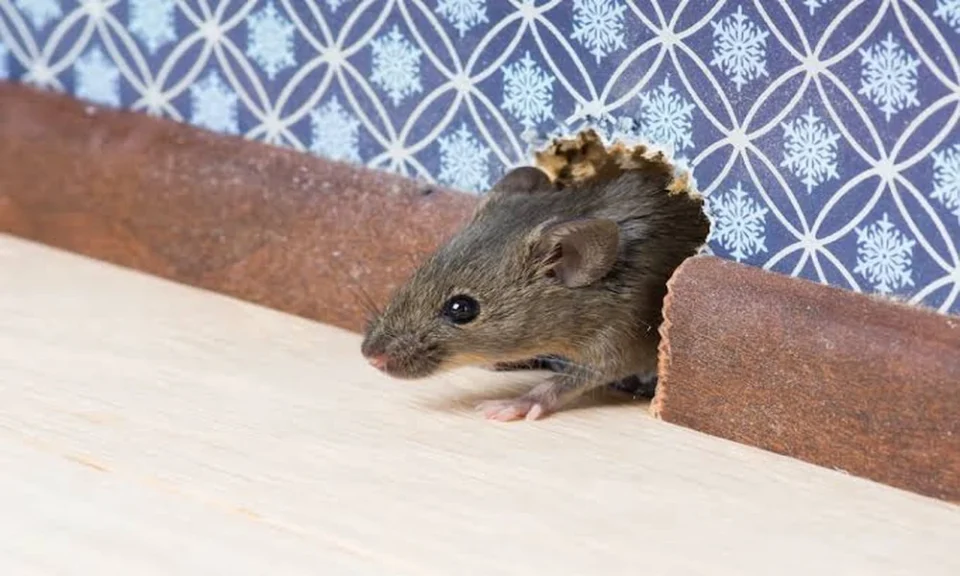
When nights in Missouri start dropping into the 40s, mice start looking for a warm place to spend the winter. Zip Zap Pest, a Lawson company led by a Board-Certified Entomologist, gets a sharp rise in rodent calls across the Northland from September through November. The same entry points turn up in house after house. Here are seven of the most common, what to seal them with, and five local companies that handle rodent control.
The house mouse is the species most often found in Missouri homes. According to the Centers for Disease Control and Prevention (CDC), mice can squeeze through an opening about the size of a dime, roughly 1/4 inch wide. Rural homes near farm fields often see extra pressure after harvest, when mice lose cover and food outdoors.
Where do mice get into Missouri homes in the fall?
1. Can mice get in under the garage door?
Yes. The garage door is the most common entry point in homes with attached garages. Rubber bottom seals crack, shrink and curl with age, and the corners where the door meets the frame often leave small gaps. Replace worn bottom seals and add brush or vinyl weatherstripping along the sides. Then seal the door between the garage and the house as well, since that’s how mice get from the garage into living space.
2. Do mice use utility lines to get inside?
Openings where lines pass through exterior walls are a common entry point. That includes air conditioner refrigerant lines, gas lines, cable and electric service. These holes are often cut larger than the line and left loosely filled. Pack gaps with copper mesh or steel wool, then cover them with exterior sealant. Expanding foam used alone doesn’t hold up, because mice chew straight through it.
3. Are dryer vents a common entry point?
Dryer vents, bathroom exhaust vents and kitchen range hood vents all give mice a direct path indoors when their flaps are broken or stuck open. Lint buildup can keep a flap from closing completely. Check each exterior vent cover for damage. Replace broken covers with a rodent-resistant design rather than adding screen over a dryer vent, because screen traps lint and can create a fire hazard.
4. Can mice get in through foundation cracks and weep holes?
Settlement cracks in poured foundations and gaps in block walls give mice easy access to basements and crawl spaces. Brick veneer homes have weep holes, small intentional gaps near the bottom of the brick that let moisture drain out. Don’t fill weep holes with mortar or caulk. That traps water in the wall. Use weep vent inserts made for this purpose, and patch foundation cracks with concrete repair products.
5. What about gaps under exterior doors?
A worn threshold or missing door sweep can leave enough space for a mouse to walk right in. Stand inside with the lights off during daylight. If you can see light under or around an exterior door, a mouse can probably get through. Adjustable thresholds and new door sweeps are inexpensive fixes that most homeowners can install.
6. Can mice really get in through the roof?
Yes. Mice climb brick, stone and rough siding without much trouble, and they reach attics through gaps at the roofline. Common spots include:
- where soffits meet the fascia
- roof returns, the short roof sections at the corners of the house
- damaged gable vents
- gaps around plumbing vent pipes
Attic entry is common in two-story homes that have trees or shrubs growing close to the house.
7. Are crawl space vents and access doors a problem?
Crawl space vents with missing or rusted screens, and access doors that don’t close tightly, give mice a sheltered route under the house. The sill plate area, where the house framing sits on the foundation, often has small gaps that lead into wall cavities. Cover vents with 1/4-inch hardware cloth. Repair or weatherstrip the access door so it closes snugly.
When should you seal these entry points?
Late summer and early fall is the best window, before outdoor temperatures drop and mice start moving indoors. Walk the outside of the house slowly with a flashlight and check each area above. Pay special attention to the side of the house nearest fields, woods or outbuildings. Seal gaps before setting traps inside. Otherwise new mice keep replacing the ones you catch.
Who handles rodent exclusion near Kansas City?
1. Kansas city pest control (ZipZap Termite & Pest Control), Lawson
Zip Zap Pest is a third-generation, family-owned company. It is led by Jeff Preece, a Board-Certified Entomologist with more than 40 years in the pest control industry and a Public Health Entomology Certificate. The company holds QualityPro certification through the National Pest Management Association.
Its rodent services include inspections, identifying entry points, control and ongoing monitoring. Year-round bundle plans can also cover termites, ants, spiders and moles. Zip Zap Pest serves Lawson, Kearney, Liberty, Excelsior Springs, Smithville, Plattsburg and rural properties with barns and outbuildings.
2. Evolution Pest Management and Termite
Evolution Pest Management and Termite is based in Excelsior Springs and offers pest control services.
3. The Family Pest Control
The Family Pest Control is located in north Kansas City and provides pest control services.
4. Presto-X Pest Control
Presto-X Pest Control operates a branch in Riverside and offers pest control services.
5. Orkin
Orkin has a branch in Lee’s Summit and provides pest control services in the Kansas City area.
Closing the Door on Fall Mice
Most fall mouse problems start at the same few places:
- garage doors
- utility penetrations
- vents
- foundation cracks
- the roofline
Sealing those gaps before cold weather arrives works far better than trapping mice after they’re already in the walls. If you’ve already heard scratching or found droppings, schedule a rodent inspection so every entry point gets found and closed.
